

Do you remember that controversy back in 1990 at the National Gallery of Canada?
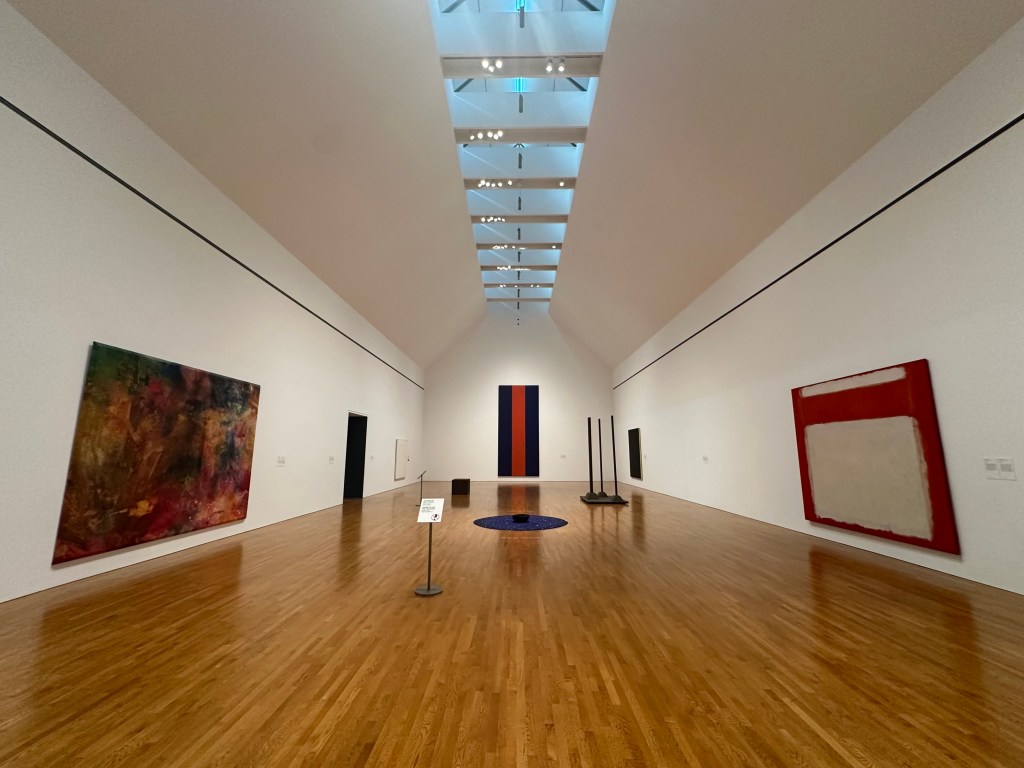
Barnett Newman’s Voice of Fire — three towering stripes in blue and red — had just been purchased by the NGC for $1.8 million. The outcry was immediate: Three stripes? I don’t get it! I could do that! The lines were repeated endlessly by the media, by visitors, by politicians. Dr. Shirley Thomson, the NGC director at the time, was called before a parliamentary committee to justify the purchase and the use of taxpayer dollars.
Today? A conservative estimate puts the painting’s value at $50 million. And just three years after the Voice of Fire purchase, the National Gallery acquired Mark Rothko’s No. 16 for $1.8 million — now valued at approximately $70 million. Not bad investments all around. The S&P 500 historically returns around 10% annually (including reinvested dividends) making a $1.8 million investment in stocks over the same period worth around $51 million today.
But the story isn’t really about money or the investment. It’s about what this one painting has meant and what it has done. It’s very possible that more people have come to see the Voice of Fire than any other artwork in the National Gallery’s permanent collection. For millions, it hasn’t been enough to see a reproduction — they’ve come to stand in front of the real thing. To witness it in the flesh, and just as importantly, to see how everyone else reacts.
Because that space — the gap between the painting and the viewer — is where something special happens. It becomes a stage for discovery and dialogue. A composition of three stripes transforms into a voice for the artist, a lens and mirror on our society, and a sounding board for the community.
In our image-saturated age, when we can zoom in on almost any masterpiece in the world from our phones, we still crave the real thing. Every year, over 10 million people wade through queues and crowds to glimpse Leonardo’s Mona Lisa at the Louvre. What are they actually seeing? What are they hoping to experience?
Whether it’s that painting in Paris, the one over the sofa at home, a child’s drawing in a school hallway, a public art commission, or the latest acquisition at a local gallery — art has a way of penetrating every sector and face of our society. We may never fully understand it, but we can’t deny its impact.
I remember as an undergraduate student attending a lecture by the New York Times art critic, John Canaday. At the end of the lecture he signed his book, Mainstreams in Modern Art, which happened to be the textbook for an art history class I was enrolled in at the time. Then John Canaday shared this thought: the next time someone tells you “I don’t know much about art but I know what I like,” tell them that the statement doesn’t make sense because you can only really like or dislike what you’ve been exposed to or seen. And his parting advice to the young art history student? Go out and look, see more, learn more, share more — and then you can decide what you really like or don’t like.
Chances are for the first-time visitor to the National Gallery of Canada on a quest to see those 18′ tall painted blue and red stripes in person, they will encounter a lot more art on that first trip. And they may even look for more. That’s part of the power of a painting: it may delight or disappoint, it often resists simple explanations, even compelling us to look closer, to look again, and again. And of all the permanent collection galleries in the NGC, I’m guessing that the arrangement of the paintings and sculptures in Gallery C214 (the home to the Voice of Fire) has changed the least. So go back for another look!


I have a feeling that Modern Art bypassed Canada and we still feel the void can’t be filled. A country without culture can’t be a country at all. The cavity must be filled or repaired in order to hear the voices of our artists.