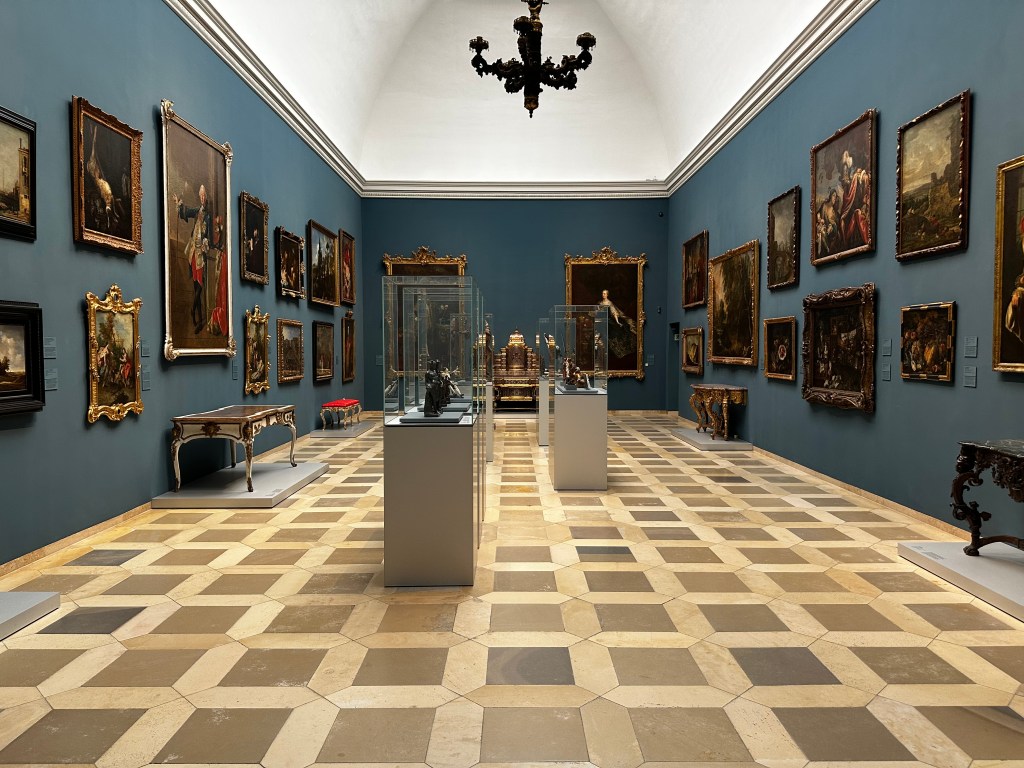

Is art truly essential to our daily lives, or is it merely an indulgence—a luxury, perhaps even irrelevant? A few years ago, I debated this very question on stage at the National Gallery of Canada with Kate Taylor of the Globe & Mail. We argued in favour of art’s essential role, while Marc Mayer, NGC Director at the time, and art critic Sarah Milroy, argued the opposite. The annual Walrus Debate was lively, but what struck me most was how easily we forget that art is not just about museums, markets, or critics. Art is about survival.
Marshall McLuhan once wrote that “Art at its most significant is a distant early warning system that can always be relied on to tell the old culture what is beginning to happen.” Art is one of our oldest languages, predating alphabets. The markings on cave walls, the painted flourishes of a medieval text, or the carvings of ancient temples are not just decorative—they are how communities recorded knowledge, beliefs, and identity long before most could read or write. Art has always been inseparable from the human story.
I think of Olivier Messiaen, the French composer captured in 1940 and sent to a Nazi prisoner of war camp. Amid the deprivation, he composed and premiered Quartet for the End of Time on broken instruments before an audience of thousands of prisoners and guards. Why make music in such a place, when survival depended on finding food, warmth, or simply avoiding a beating? As Karl Paulnack of Boston University once noted, the very existence of poetry, music, and art from the camps shows that art must somehow be essential. Paulnack wrote: “It is part of the human spirit, the unquenchable expression that allows us to say: I am alive, and my life has meaning.”
This truth is not confined to history. I’ve seen it in the sculptures of Inuit artists, carrying stories of colonization, displacement, and resilience. I’ve seen it in the work of newcomers and young artists today, who use their practice as a lifeline—a way to process trauma, assert identity, or imagine a different future. These works are not created for the market; they are acts of survival, healing, and resistance.
Art also permeates our daily lives in less dramatic but no less vital ways. It is on the book cover we reach for before bed, in the music streaming on our morning commute, in the design of the buildings we enter, and even on the cereal box at breakfast. We don’t choose whether art is present—it already surrounds us. What we choose is how much we notice, value, and nurture it.
I often speak about art as both mirror and catalyst. It reflects who we are, but it also pushes us forward. Art sharpens perception, deepens empathy, and opens the space to imagine futures that do not yet exist. It is central to civic life because it holds us accountable: to see one another more fully, to wrestle with difficult histories, and to imagine what justice, belonging, and beauty might look like tomorrow. Without art, communities risk becoming flat, functional, and transactional. With art, they remain textured, imaginative, and alive.
History teaches us that once basic needs are secured, humans everywhere turn instinctively to creativity. Quilts stitched in secret, songs sung in defiance, murals painted on the walls of occupied cities—these are not luxuries, they are testimonies of existence.
Art is not an accessory to life—it is life itself: how we record, resist, imagine, and endure. To dismiss it as irrelevant is to misunderstand what it means to be human.
Looking back, I’m not actually sure who won that Walrus Debate. The moderator, CBC host Carol Off, called it a tie! — Stephen